SKIP SCHUMAKER? TEXAS RANGERS FACE A MAJOR TURNING POINT AFTER DISAPPOINTING 2026 SEASON
The Texas Rangers Miss the Playoffs Again as Questions Surround the Team’s Future Under Manager Skip Schumaker
The Texas Rangers have reached another difficult moment in their journey to reclaim their position among Major League Baseball’s elite teams. After entering the 2026 season with renewed optimism and high expectations, the Rangers finished the campaign without securing a postseason place, leaving players, supporters, and the organization reflecting on what went wrong.
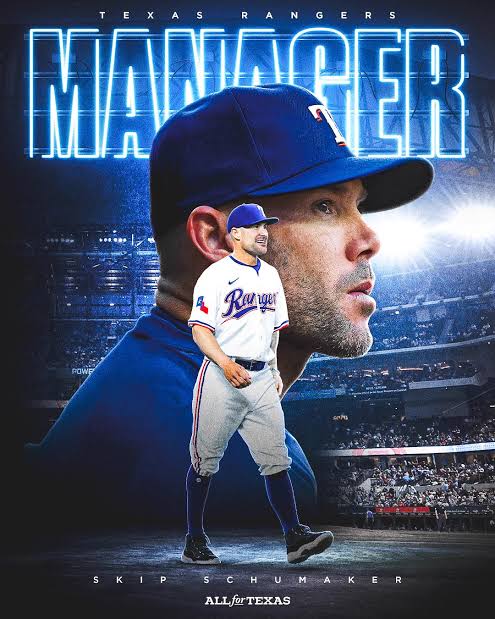
The headline “Farewell, Texas Rangers Manager Skip Schumaker” has attracted attention on social media, raising questions about the manager’s future and the direction of the franchise. However, the image circulating online does not establish that Schumaker has been dismissed or that he has announced his departure. The confirmed story is that Texas missed the playoffs for the third consecutive season following its historic World Series triumph in 2023.
For a franchise that reached the summit of baseball just three years ago, the disappointment is significant. The Rangers had hoped that appointing Schumaker would help restore consistency, strengthen the team’s identity, and return the organization to championship contention.
Instead, the 2026 season ended with more questions than answers.
A Painful Ending to the 2026 Campaign
The Rangers entered the final weekend of the regular season with an opportunity to secure the American League West title. Their hopes remained alive until the final day, creating an atmosphere of urgency as they attempted to overcome their rivals, the Houston Astros.
Unfortunately for Texas, the final results did not go their way.
The Rangers suffered a 6–4 defeat against the Minnesota Twins in their season finale, while Houston defeated the Athletics 9–0. Those results left Texas with an 80–82 record, one game behind the Astros, who finished 81–81 and claimed the division title.
The outcome was particularly frustrating because the Rangers had entered the final stretch believing that a postseason opportunity was still within reach.
Instead of celebrating a division championship or preparing for October baseball, the players found themselves exchanging farewells and reflecting on a campaign that had fallen short of expectations.
For the supporters who had hoped to see their team return to the postseason, the ending was difficult to accept. Texas had come close enough to keep its hopes alive until the final day, but it could not complete the job.
The defeat also highlighted a problem that had followed the Rangers throughout the season: their inability to maintain consistent performances when the pressure was greatest.
Although they remained in contention late in the campaign, their earlier struggles ultimately proved too costly.
Skip Schumaker’s First Season Under Pressure
When Skip Schumaker became the Rangers’ manager, expectations were high.
Texas appointed him in October 2025 on a four-year contract covering the 2026–2029 seasons. He became the 21st full-time manager in franchise history, replacing Bruce Bochy, who had helped deliver the organization’s first World Series championship in 2023.
Schumaker arrived with an impressive reputation. During his time managing the Miami Marlins, he demonstrated an ability to organize a competitive team and guide players through a demanding regular season.
His first campaign with Miami was particularly successful. In 2023, he led the Marlins to an 84–78 record and a postseason appearance, earning National League Manager of the Year honors.
That achievement strengthened his reputation as one of baseball’s promising managerial talents.
The Rangers therefore believed he could bring fresh ideas, renewed energy, and a stronger competitive mentality to their clubhouse.
However, managing expectations at a club that recently won a championship can be challenging. Supporters do not simply want improvement; they want evidence that the team can compete for major honours again.
Schumaker’s first season in Texas ended without a playoff appearance, meaning his next steps will attract considerable attention.
Nevertheless, one disappointing campaign does not automatically mean that a manager’s tenure is over. The image announcing a farewell should therefore not be interpreted as official confirmation that Schumaker has left the organization.
The immediate question is whether the Rangers can address their weaknesses and build a stronger team around their current leadership.
The Rangers’ Decline Since Their Historic Championship
The Rangers’ recent struggles become clearer when viewed against their remarkable achievement in 2023.
That year, Texas captured its first World Series title, rewarding years of investment and rebuilding. The championship demonstrated that the organization could assemble a roster capable of succeeding against baseball’s strongest opponents.
However, maintaining that level of success has proved difficult.
Following their championship season, the Rangers failed to return to the postseason in 2024, 2025, or 2026.
Their regular-season records during those three campaigns were 78–84, 81–81, and 80–82, respectively. The team has therefore struggled to establish the consistency required to compete for a division title or secure a wild-card position.
These results have raised concerns about the organization’s ability to sustain its championship standard.
Winning the World Series is a major achievement, but repeating that success requires more than a talented starting lineup. Teams must also manage injuries, develop younger players, maintain pitching depth, and respond effectively when established players experience poor form.
The Rangers have faced difficulties in several of these areas.
Although they have continued to feature experienced players and talented young prospects, the overall results have not matched the ambitions of the organization.
For Schumaker, this situation presents an important challenge. He must help the Rangers rediscover the qualities that made them champions while finding solutions to the problems that have contributed to their recent decline.
Road Performances Become a Major Concern
One of the most significant weaknesses during the 2026 season was Texas’ performance away from home.
The Rangers finished with a 35–46 record on the road, demonstrating how difficult it was for them to produce consistent results outside their home stadium.
Their performance against teams with losing records was another concern. Texas recorded a 33–38 mark in those matchups, meaning the club lost more games than it won against opponents it might reasonably have expected to defeat.
These numbers help explain why the Rangers entered the final weekend needing favourable results to remain in contention.
In a long baseball season, every game matters. A team can recover from a difficult series, but repeated losses against struggling opponents can gradually damage its chances of reaching the postseason.
The Rangers were unable to avoid that pattern.
Their road struggles placed additional pressure on their home performances, while missed opportunities against weaker teams reduced the margin for error during the final weeks.
Schumaker acknowledged that the team’s results in these situations were not good enough and accepted responsibility for finding a way forward.
His comments reflected an understanding that improvement must begin with an honest assessment of the team’s shortcomings.
The Rangers cannot rely entirely on individual brilliance or late-season victories. They must become a more dependable team throughout the entire schedule.
Injuries and Missed Opportunities Complicate the Playoff Push
The Rangers’ disappointing finish was not simply a matter of poor performances. Injuries to important players also complicated their efforts to reach the postseason.
During the final weeks of the campaign, Texas lost significant offensive production when Joc Pederson suffered a fractured left hand and Josh Jung sustained a right-hand fracture.
Those absences weakened the team’s lineup during a period when every victory was crucial.
The Rangers needed their experienced hitters to produce consistently, but injuries reduced the options available to Schumaker as the club attempted to remain competitive.
The situation became even more difficult when shortstop Corey Seager continued to deal with health concerns.
Seager hit his 20th home run in the season finale against Minnesota, but his overall offensive production declined compared with previous years. His final on-base-plus-slugging percentage, a statistic combining on-base ability and power, was a career-low .736.
Despite that decline, Seager remained an important part of the team’s offensive structure.
He emphasized the need to find small improvements that could help Texas turn close games into victories.
His point was important because baseball seasons often depend on narrow margins. A timely hit, a productive at-bat, or an additional out recorded by the pitching staff can determine whether a team wins or loses.
For the Rangers, too many of those opportunities ended unsuccessfully.
The combination of injuries, inconsistent hitting, and difficult performances at crucial moments ultimately contributed to their failure to secure a postseason position.
Corey Seager and the Search for Offensive Consistency
Corey Seager remains one of the most recognizable players on the Rangers roster, but his 2026 campaign illustrated the difficulties the team experienced offensively.
The shortstop continued to demonstrate his ability to hit for power, reaching the 20-home-run mark in the final game.
However, his overall production was below his previous standards.
For a team attempting to return to championship contention, performances from leading hitters are particularly important. Established stars are often expected to provide stability when younger players experience difficulties or when injuries affect the lineup.
When those contributions decline, the entire team can feel the impact.
Seager’s situation also highlights the importance of offseason preparation. His recovery, physical condition, and readiness for the next campaign will be important considerations as the Rangers plan for the future.
Texas will need to determine how best to support its established players while ensuring that the lineup has sufficient depth to withstand injuries.
The team cannot depend on a small number of individuals to carry the entire offensive burden.
Instead, it must develop a more balanced approach in which several players can contribute runs, extend innings, and take advantage of scoring opportunities.
That balance could be essential if the Rangers hope to challenge for the division title in the next season.
Schumaker Accepts Responsibility for the Disappointment
Following the end of the campaign, Schumaker acknowledged that the Rangers had not achieved their main objective.
His comments reflected disappointment but also a determination to identify the changes necessary to improve the club.
The manager recognized that the roster contained considerable talent, making the failure to reach the postseason especially frustrating.
He also indicated that the offseason would require careful self-examination and an assessment of how the team could move forward.
Such an approach is important because a manager’s responsibilities extend beyond selecting players for individual games.
Managers must help establish standards, maintain discipline, communicate effectively with their players, and create an environment in which the team can respond positively to adversity.
When a club repeatedly falls short of its objectives, the manager must examine whether its preparation, strategy, and overall approach are producing the desired results.
Schumaker’s challenge will be to translate that reflection into practical improvements.
The Rangers need a clearer plan for dealing with difficult stretches, managing player workloads, and responding when their offensive production declines.
They must also determine how to use their younger players without placing excessive pressure on them.
The coming months will provide an opportunity for the coaching staff and front office to evaluate those questions.
What Happens Next for the Texas Rangers?
The end of the 2026 season marks the beginning of an important offseason for Texas.
The organization must assess its roster, examine its financial priorities, and determine which areas require the most urgent attention.
Pitching depth will remain important, as will the need for reliable offensive production throughout the lineup.
The Rangers must also evaluate the development of their younger players and decide how those prospects can contribute to the major-league team.
An effective offseason does not necessarily require replacing every struggling player or making dramatic changes to the roster.
Sometimes, the most important improvements come from addressing specific weaknesses, strengthening the supporting cast, and helping established players return to their best form.
Texas also needs to improve its ability to win games against opponents it should be capable of beating.
Its 2026 road record and results against teams with losing records demonstrate that consistency must become a priority.
If the Rangers can improve in those areas, they may place themselves in a stronger position to compete for the American League West title.
The front office must also consider how much responsibility should fall on the manager and how much is connected to roster construction, injuries, and player performance.
Baseball success is rarely determined by one individual alone. It depends on cooperation among the manager, coaching staff, front office, and players.
Any serious attempt to restore the Rangers’ championship ambitions will require all those groups to work toward the same objectives.
Is This Really Farewell to Skip Schumaker?
Despite the dramatic wording of the circulating image, there is an important distinction between speculation about a manager’s future and confirmation of an official departure.
The image presents Schumaker’s situation as a farewell, but it does not provide a statement from the Texas Rangers announcing his dismissal or resignation.
The club appointed him to a four-year contract covering the 2026–2029 seasons. That agreement provides important context, although a contract alone cannot guarantee that a manager will remain in the position for its entire duration.
The Rangers’ disappointing season will naturally lead to questions about accountability and the direction of the franchise.
Supporters may debate whether Schumaker should receive more time to implement his ideas or whether the organization needs a different approach.
However, those discussions should not be confused with an officially confirmed managerial change.
For now, the central story is the Rangers’ failure to reach the playoffs and the difficult decisions facing the organization as it prepares for another campaign.
Schumaker’s future should be discussed in light of verified announcements rather than a headline designed to attract attention.
Conclusion: A New Chapter Must Begin in Texas
The Texas Rangers entered 2026 hoping to make meaningful progress after two seasons without postseason baseball. Instead, they finished with an 80–82 record and missed the playoffs for the third consecutive year since winning the World Series in 2023.
Their final-day defeat against Minnesota, combined with Houston’s victory over the Athletics, ended their hopes of winning the American League West.
Injuries, inconsistent road performances, offensive struggles, and missed opportunities all contributed to the disappointing result.
For Skip Schumaker, the campaign represents an important test of his leadership and ability to help the team recover.
For the Rangers’ front office, it is an opportunity to examine the roster and determine what must change before the next season.
And for the supporters, the priority remains the same: seeing their team return to the postseason and compete for another championship.
Whether Schumaker continues as manager or the organization eventually chooses a different direction, Texas must find a way to turn its potential into consistent results.
The 2023 championship proved that the Rangers are capable of reaching the highest level of baseball. Their challenge now is to rediscover that winning formula.