The Goal That Made Slavia Prague History
Some football moments live far beyond the final whistle. They become part of a club’s identity, remembered by supporters years after the players have moved on and the stadium has changed. For Slavia Prague, one of those unforgettable moments came on September 19, 2007, during a historic UEFA Champions League encounter against Steaua Bucharest.
It was a night filled with pressure, expectation and the desire to create history. Slavia had reached the Champions League group stage, giving the club an opportunity to compete on one of European football’s biggest stages. For the players and supporters, every minute of the match carried enormous significance. They were not simply playing another European fixture; they were representing the club at the highest level and trying to create a memory that would last for generations.
Then came the 63rd minute.
Stanislav Vlček found himself in a position to influence the game and chose to allow the ball to continue toward a young teammate. That teammate was twenty-year-old Tijani Belaid, a talented midfielder who was still at the beginning of his professional journey.
Belaid did not hesitate.
He connected with the ball and sent it into the back of the net.
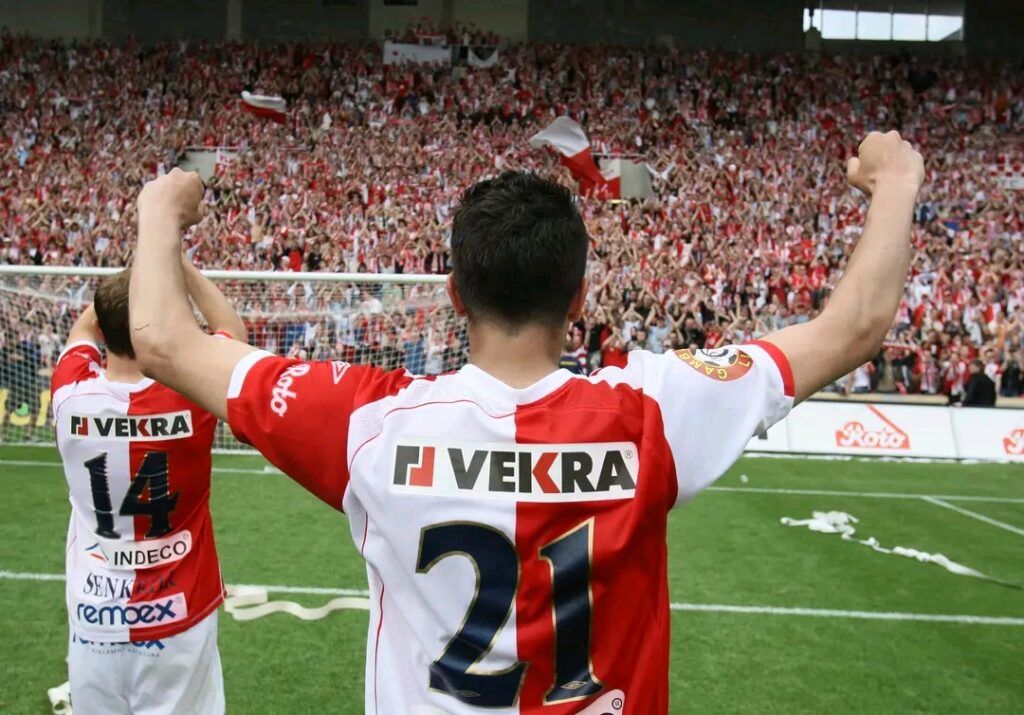
The stadium erupted.
In a single moment, the young player became part of one of the most important chapters in Slavia’s modern European history.
The goal was more than simply a successful finish. It represented ambition, belief and the reward for a team that had fought its way onto the Champions League stage. For Slavia’s supporters, it was the kind of moment that every football fan dreams of witnessing: a decisive goal in a major European competition, scored by a young player at a moment when his team needed him most.
Years have passed since that September evening, but the memory remains powerful.
For Belaid himself, the goal became one of the defining moments of his football career. At just twenty years old, he had experienced something that many professional footballers spend their entire careers hoping to achieve. He had scored a decisive Champions League goal for a historic club and helped Slavia write an important page in its European football story.
The circumstances surrounding the goal also make it particularly memorable.
Football is often described as a team sport, and the goal against Steaua perfectly demonstrated that idea. Vlček’s decision to leave the ball for Belaid created the opportunity, while Belaid’s composure and finishing ability completed the move. One player’s awareness combined with another player’s instinct, producing a moment that would become permanently connected with Slavia’s Champions League history.
For supporters watching in the stadium, the goal would have been an explosion of emotion. European nights carry a different atmosphere, particularly when a club is competing against one of the continent’s established teams. The pressure is intense, the stakes are high and every goal can change the entire story of a match.
That is exactly what happened.
Belaid’s strike transformed a tense encounter into a historic occasion. His name was suddenly being spoken by thousands of supporters, and his goal became a symbol of Slavia’s determination to make an impact in Europe’s premier club competition.
The significance of the moment becomes even clearer when viewed through the perspective of time.
Young footballers often dream about scoring in major competitions. They imagine themselves standing in front of a packed stadium, hearing supporters celebrate and knowing that their contribution could become part of club history. For Belaid, that dream became reality at a remarkably young age.
But memories of football are rarely limited to what happened on the pitch. Players also remember the emotions surrounding those moments: the atmosphere inside the stadium, the reaction of teammates, the supporters celebrating, and the feeling immediately after the ball crosses the goal line.
That is why looking back at Belaid’s experience is so fascinating.
What was going through his mind before the finish?
Did he fully understand the importance of the moment while it was happening?
What did he feel when he saw the ball enter the net?
And how did the experience influence his career afterward?
These are the kinds of questions that make football history personal rather than simply statistical.
A match report can tell us who scored, when the goal was scored and what the final result was. But only the player can explain what that moment truly felt like. Behind every famous goal is a human story involving pressure, preparation, confidence, fear, excitement and sometimes a little bit of instinct.
For Belaid, the 2007 Champions League match against Steaua remains a particularly important part of that story.
The young midfielder had been given an opportunity to perform on one of football’s grandest stages, and he responded in the most memorable way possible. Instead of being overwhelmed by the occasion, he became one of its central figures.
That is what makes historic goals so special.
They can change how a player is remembered.
Before the match, Belaid was a promising twenty-year-old footballer. After scoring the decisive goal, he became a player whose name was permanently connected with one of Slavia’s most memorable European nights.
The goal also became an important reminder of how quickly football can change a player’s fortunes. A single touch, a single decision or a single shot can become the moment that supporters remember for decades.
Slavia’s Champions League campaign gave the club a chance to test itself against some of Europe’s strongest sides. For the players, it was an opportunity to prove that they belonged at the highest level. For the supporters, it was a chance to see their club compete among Europe’s elite.
And in the middle of that historic journey was a young Tijani Belaid.
His goal against Steaua was therefore not simply an individual achievement. It became part of the larger story of Slavia Prague’s European ambitions.
Football supporters often have their own memories of historic goals. Some remember exactly where they were standing. Others remember who they were watching the match with. Some can still recall the sound of the crowd or the moment they celebrated with friends and family.
That is the emotional power of football.
A goal lasts only a few seconds, but the memory can last a lifetime.
For Slavia supporters, Belaid’s goal is one of those moments.
More than a decade later, the story continues to attract attention because football history is constantly being rediscovered by new generations. Young supporters who were not old enough to experience the match can now learn about the players and moments that helped shape the club’s identity.
And when the player himself reflects on the occasion, the story becomes even more meaningful.
Belaid’s memories provide a unique perspective on what happened that night. Rather than simply looking at the goal through statistics or old match footage, supporters can hear the story directly from the man who stood at the centre of the moment.
That is the appeal of an intimate football interview.
It allows fans to go behind the famous image and discover the emotions and thoughts that existed before, during and after the historic event.
The upcoming feature gives Belaid an opportunity to look back on his time at Slavia, his experiences in European football and, most importantly, the goal that helped make him a memorable figure in the club’s Champions League story.
For supporters, it is a chance to revisit one of the most exciting moments in Slavia’s European history.
For Belaid, it is an opportunity to remember a period of his career when he was a young footballer living a dream on the biggest stage.
And for football lovers everywhere, it is another reminder of why the sport remains so powerful.
Players come and go. Teams change. Competitions evolve. Stadiums become modernized and new generations take the place of those who came before them.
But historic goals remain.
They become stories passed from one supporter to another.
They become moments shown in highlight videos.
They become memories recalled during interviews.
And sometimes, they become part of a club’s identity.
September 19, 2007, will forever be associated with one such moment for Slavia Prague. In the 63rd minute against Steaua Bucharest, Stanislav Vlček allowed the ball to reach a young Tijani Belaid. The twenty-year-old midfielder took his opportunity and fired the ball into the net.
It was a goal that carried enormous significance.
It was a goal that helped Slavia make history.
And it was a goal that ensured Belaid’s name would forever be remembered whenever supporters look back on that remarkable Champions League night.
Now, years later, the story is being revisited from the perspective of the man who scored it.
How does Tijani Belaid remember that unforgettable moment?
What was happening inside his mind when he received the ball?
What did the goal mean to him at the time?
And how does he view that historic night today?
Those questions provide the foundation for a fascinating trip back in time.
Because sometimes the best way to understand football history is not simply to look at the scoreboard, but to listen to the people who lived it.
And when the story involves a young player, a historic European night, a decisive goal and a stadium full of passionate supporters, there is no shortage of memories worth revisiting.
The goal may have lasted only seconds.
But its place in Slavia Prague’s history has lasted far longer.
Tijani Belaid was twenty years old when he wrote his name into that history.
More than a decade later, the memory remains.
And that is perhaps the greatest compliment football can give a player: to create a moment that people never stop talking about.