Bono and The Edge Receive 2025 Woody Guthrie Prize, Reaffirm Music’s Power as a Force for Justice
Tulsa, Oklahoma — Cain’s Ballroom, one of America’s most storied music venues, became a place of reflection, remembrance, and renewed purpose on Thursday night as Bono and The Edge of U2 were awarded the 2025 Woody Guthrie Prize. The honor, presented annually by the Woody Guthrie Center, recognizes artists whose work embodies Guthrie’s enduring legacy of social conscience, protest, and the belief that music can challenge injustice while giving voice to the unheard.
Presented by Woody Guthrie’s granddaughter, Anna Canoni, alongside Woody Guthrie Center Director Cady Shaw, the ceremony celebrated more than U2’s four-decade career. It underscored the band’s longstanding commitment to the idea that popular music is not merely entertainment but a living, breathing force for justice and truth. In their introduction, the presenters highlighted how Bono and The Edge “stand firmly in the belief that popular music is also a force for justice and truth,” a principle that has guided U2 from their earliest post-punk anthems to their most recent work.
Cain’s Ballroom, long associated with roots music, rebellion, and cultural exchange, proved a fitting location for the occasion. Woody Guthrie himself, an Oklahoman whose songs chronicled the struggles of working people and the dispossessed, loomed large over the evening—not as a distant historical figure, but as a living influence whose spirit still resonates in contemporary struggles across the globe.
A Night of Music and Meaning
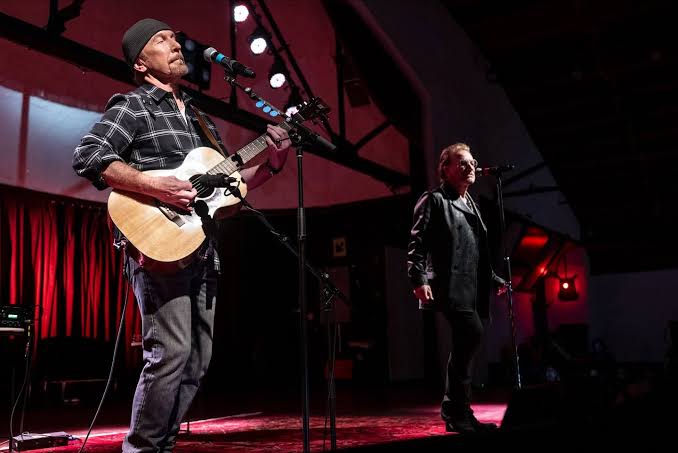
The evening unfolded with a stripped-back six-song performance by Bono and The Edge, reminding the audience why U2’s music has remained so influential across generations. Without elaborate staging or spectacle, the duo leaned into the raw emotional core of their songs, allowing lyrics and melodies to take center stage. The performance served as both a tribute to Guthrie’s tradition of simplicity and a testament to U2’s ability to communicate complex ideas through accessible, emotionally resonant music.
Following the set, Bono and The Edge were joined on stage by acclaimed producer and songwriter T Bone Burnett for an extended conversation on art, responsibility, and activism. Burnett, himself a longtime collaborator with artists who blur the line between music and social commentary, guided a discussion that ranged from the creative process to the moral weight artists often carry in moments of global crisis.
Bono was candid about the limits of intention in songwriting. “You can’t write a song to order,” he said, emphasizing that music cannot be reduced to slogans or forced messages. Instead, he explained, songs emerge when an idea, an emotion, or an image refuses to let go. That sense of inevitability, he suggested, is what gives music its enduring power.
“One Life at a Time”: A Song Born from Tragedy
The conversation took a deeply emotional turn when Bono shared lyrics from a new work in progress—one inspired by the July 2025 killing of Awdah Hathaleen, a Palestinian activist and consultant on the Oscar-winning documentary No Other Land. Hathaleen’s work, alongside Israeli director Yuval Abraham and Palestinian filmmaker Basel Adra, had drawn international attention to the realities of life in the occupied territories. His death, described by Adra as the result of an out-of-control Israeli settler in the South Hebron Hills, sent shockwaves through activist and artistic communities alike.
Adra’s words following the killing—describing it as an attempt to erase his people “off the face of the earth one life at a time”—struck Bono with particular force. He told the audience that the phrase haunted him, echoing in his mind long after he first encountered it. “I called Edge,” Bono recalled, “because that phrase, one life at a time, wouldn’t leave me alone.”
What resonated most, Bono explained, was the phrase’s dual meaning. “The phrase can work both ways,” he said. “You can break or make the world one life at a time.” That tension—between destruction and creation, despair and hope—became the emotional axis of the song. The Edge, Bono noted, already had a piece of music that seemed to carry the same weight, and the collaboration unfolded organically. “We didn’t have much choice about this,” Bono said. “That’s how songs work.”
The lyrics Bono shared were stark and unflinching, refusing to look away from violence while insisting on the humanity at its center:
One father shot
Three children crying
If there is no law
Is there no crime?
If there is no hope,
What’s there to rhyme?
History is written
One life at a time
One life at a time
The verses continued with imagery that interrogates the distortion of faith and history:
Look around
Who stole Abraham who stole his words?
Stole the colours from the flowers
Stole the song from the birds?
Who stole Mohammad locked him in a cage?
Made God a mirror of our own rage?
The refrain returns to the image of children pleading for their father’s life, a moment that collapses political abstraction into human reality:
“Don’t shoot my father” his three children are crying
Innocence flees the scene of the crime
We can make or break the world
ONE LIFE AT A TIME
The audience listened in silence, many visibly moved. The lyrics did not offer easy answers or ideological prescriptions. Instead, they posed questions—about law, hope, faith, and responsibility—that lingered long after the final line was spoken.
Art, Activism, and the Guthrie Tradition
The Woody Guthrie Prize has long honored artists who use their platforms to confront injustice, and Bono and The Edge join a lineage of recipients who view music as inseparable from moral inquiry. Guthrie himself believed that songs could be weapons against hatred and tools for solidarity, a belief famously encapsulated in the slogan “This machine kills fascists” emblazoned on his guitar.
In many ways, U2’s career mirrors that ethos. From songs addressing civil rights and apartheid to more recent work grappling with global inequality and conflict, the band has consistently engaged with the world beyond the stage. Yet, as Bono emphasized during the discussion, engagement does not mean certainty. “The job of art isn’t to give people answers,” he suggested, “but to help them ask better questions.”
Cady Shaw, Director of the Woody Guthrie Center, echoed that sentiment in her remarks, noting that U2’s music has always existed at the intersection of personal reflection and public responsibility. “They understand,” she said, “that music can hold pain and hope in the same breath.”
A Moment That Resonates Beyond Tulsa
As the evening drew to a close, it was clear that the ceremony had transcended the boundaries of a typical awards event. It became a meditation on how artists respond to a fractured world and how individual lives—whether those of musicians, activists, or children caught in conflict—shape history in ways both profound and fragile.
Bono and The Edge accepted the 2025 Woody Guthrie Prize with humility, framing the honor not as a culmination but as a reminder of ongoing responsibility. In a world increasingly defined by polarization and violence, their message was both sobering and quietly hopeful: change does not arrive all at once, nor does destruction. Both happen incrementally, through choices made and lives touched.
As the final words of the new song echoed through Cain’s Ballroom, the message felt unmistakably clear. Whether through music, activism, or simple acts of humanity, the world is indeed made—or broken—one life at a time.