Chaos or Control? The Unanswered Rock War That Still Divides Fans: Guns N’ Roses vs. Metallica
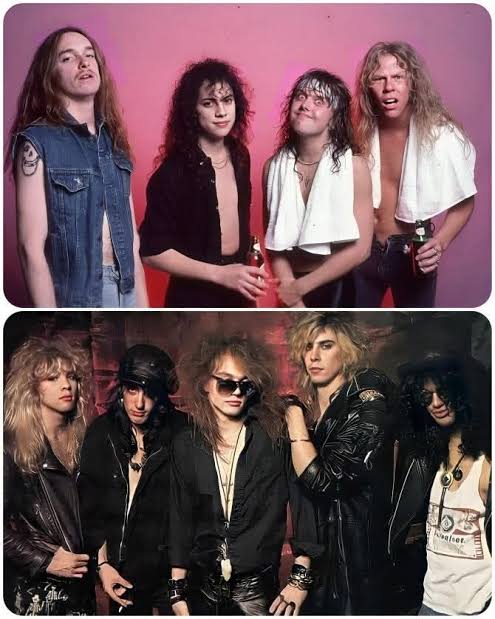
In the world of rock music, few rivalries have generated as much fascination, controversy, and passionate debate as the ongoing saga between Guns N’ Roses and Metallica. For more than three decades, fans and critics alike have argued over whether this clash was simply professional competition or a deeper cultural clash within the music world — and even today, the debate rages on.
While both bands are now iconic representatives of heavy music and stadium success, their shared history includes triumphant shows, devastating setbacks, outspoken insults, and even riots that have come to define a turbulent chapter in rock history.
The Beginnings: Two Titans of 1990s Rock
In the late 1980s and early 1990s, the musical landscape of rock and metal was exploding in popularity. Metallica had reshaped heavy metal with groundbreaking albums like …And Justice for All and the massively influential Metallica (also called The Black Album), which propelled them into mainstream consciousness with hits like “Enter Sandman.” Meanwhile, Guns N’ Roses had emerged as a powerful force with their gritty, rebellious sound on Appetite for Destruction and their ambitious Use Your Illusion I & II releases.
As both bands ascended toward the peak of their popularity, comparisons between them naturally followed. Fans of one would inevitably contrast their favorite act with the other, arguing who was heavier, who was more authentic, who ruled rock. According to fan discussions and commentators looking back decades later, both bands had huge followings at the time — Guns N’ Roses arguably more mainstream initially, with Metallica’s fanbase exploding as The Black Album dominated charts and sold millions of copies.
The 1992 Co‑Headlining Tour: Sparks That Lit the Fire
The true flashpoint in what would become the legendary rivalry was the 1992 co‑headlining tour featuring both Guns N’ Roses and Metallica. Promoted as a dream pairing of two of the era’s biggest rock giants, the tour seemed poised to be historic. Yet, from the outset, tensions simmered. Inside sources describe the backstage atmosphere as competitive, hierarchical, and constantly on edge — the two bands had different approaches, management styles, and expectations.
Metallica members were seen as disciplined and punctual, while Guns N’ Roses had developed a reputation for unpredictability and rebellion. On some nights, the problems were logistical — late starts, sound issues, and missed cues — and on others, they were personal and public. At one early show, Metallica’s set was interrupted after frontman James Hetfield was accidentally burned by pyrotechnics. Later in the evening, Guns N’ Roses performed nearly three hours late and then abruptly ended their set early, prompting discos and riots from frustrated fans.
The notorious stop at Montreal’s Olympic Stadium on August 8, 1992, remains one of the most infamous moments in live rock history. After Hetfield’s injury forced Metallica to end its set early, fans expected Guns N’ Roses to take the stage soon afterward. Instead, the crowd was left waiting for hours, only for the GNR set to end prematurely again — triggering chaos. An estimated 2,000 people rioted inside and outside the stadium, overturning police cars, lighting bonfires, and causing extensive damage to the facility.
The incident left an indelible mark — both on the bands’ reputations and on the perception of fan loyalty. For many Metallica supporters, the episode symbolized what they saw as Guns N’ Roses’ unprofessionalism. For others, the entire situation underscored how unpredictable big rock tours could be, especially when personalities clashed and egos collided.
Words That Fuelled the Fire
While the tour’s logistical nightmares were dramatic enough, words exchanged offstage — and later in interviews — helped solidify the rivalry’s mythology. Members of both bands were not shy about their opinions. After the tour, Guns N’ Roses frontman Axl Rose infamously referred to Metallica as “cartoon characters,” a dismissive line that was widely quoted and debated among fans. In turn, Metallica’s James Hetfield reportedly quipped in interviews that GNR was “a different type of band — and I use the word ‘band’ loosely.”
Former Guns N’ Roses drummer Matt Sorum later commented that there was a competitive nature brewing from the start, especially between Rose and Metallica’s Lars Ulrich. Both men were described as ambitious and intent on dominating the rock world — a dynamic that may have pushed both bands to excel, but also created tension.
Other exchanges over the years, including occasional barroom confrontations and pointed remarks in the press, kept the rivalry alive — not always with hatred, but often with enough edge to keep fans invested in the narrative.
A Rivalry Beyond the Bands: Fan Divisions and Cultural Identity
For fans, the rivalry extended far beyond the bands themselves. In many ways, Guns N’ Roses and Metallica represented different approaches to rock — and this sparked intense debates in forums, comments sections, and fan circles.
To some, Guns N’ Roses epitomized raw rock ’n’ roll attitude — chaotic, rebellious, and larger than life. They appealed to listeners who loved outspoken personalities, hook‑laden music, and theatrical stage presence.
To others, Metallica represented precision, discipline, and technical mastery — a band that forged a new direction for heavy metal and sustained relevance across decades. Their fans often pointed to album sales, longevity, and influence as proof of superiority. In some debates, Metallica’s success with the Black Album alone was used as evidence of their broader cultural impact.
Despite these differing fan identities, many music enthusiasts have pointed out that the comparisons are often apples and oranges — two powerful acts with overlapping but distinct styles both deserving of respect.
Reconciliation and Reflection: Recent Developments
After years of muted tension and sporadic public reminders of their fraught past, the relationship between the two bands has shown signs of thawing — not least at high‑profile events. In July 2025, at Black Sabbath’s farewell concert “Back to the Beginning,” multiple rock legends shared the stage and the spotlight, including Guns N’ Roses and Metallica. In a symbolic moment for many, frontmen Axl Rose and James Hetfield were photographed together backstage — a quiet but meaningful reunion after decades of separation.
This interaction didn’t erase history, but it did show a shift from bitter rivalry to respectful professionalism — a transition that many fans hoped would one day happen.
Perhaps even more significant for the rock community is the announcement of the “Legends Reloaded” 2026 Stadium Tour, which will see both acts sharing billing once again. Scheduled to hit major venues across North America and Europe, this joint tour promises to celebrate their legacies without the hostile edges of the past. Each band will perform full headline sets, and organizers have hinted at festival‑style production that honors both catalogs.
For many observers, the announcement is a sign that rock music’s greatest rivalries can evolve into collaborations that honor the past while looking forward — a sentiment echoed by fans who once argued endlessly about whose music was “better.”
The Legacy of a Rock War
Even with signs of reconciliation, the debate over Guns N’ Roses vs. Metallica continues to thrive — and perhaps it always will. For die‑hard fans, the rivalry was never just about music; it represented a clash of personalities, values, and visions for the future of rock. In this sense, the “rock war” became a cultural moment that transcended charts and stadiums.
Yet it’s important to note that for many others, the rivalry was either exaggerated by media narratives or simply a product of passionate fandom. Many rock listeners enjoyed both bands, appreciated their different strengths, and saw the supposed feud as entertainment rather than deep division. Indeed, discussions in online communities often reveal fans who love both acts and find the comparisons either irrelevant or fun rather than serious.
Ultimately, the story of Guns N’ Roses and Metallica is a reminder of how competitive dynamics can shape musical history, fan culture, and collective memory. Whether labeled as chaos or control, rivalry or respect, the narrative continues to define a generation of rock listeners.
As the rock world anticipates the summer of 2026 and the return of these legends to shared stages, the question remains not just who won — but what this rivalry taught us about music, fandom, and the enduring power of rock ’n’ roll.